Business directory websites remain profitable in 2026, but successful monetization strategies have evolved significantly. Modern directories function as data hubs, lead generation platforms, and trust intermediaries between customers and businesses, rather than simple listing repositories.
This guide examines how “Business directory websites continue to operate as sustainable digital businesses in 2026…”, which monetization models remain effective, and what strategies distinguish profitable directories from struggling ones.
“This article is for informational purposes only and does not guarantee specific revenue outcomes, as results vary based on execution, niche, and market conditions.”
Why Business Directory Websites Remain Viable
Understanding the continued relevance of directory websites requires examining search behavior patterns.
Users consistently search for:
- Services in their local area
- Business contact information
- Reviews and comparisons
- Trusted local providers
Search engines continue to reward structured, intent-focused platforms that aggregate reliable business data. According to insights from Search Engine Journal and Google’s local search documentation, directories play an important role in business discovery and data verification.
This sustained demand creates monetization opportunities.
Why Monetization Must Serve Users First
“Sustainable directory monetization depends on user trust. When directories prioritize accurate data, verified businesses, and helpful discovery experiences, monetization becomes a byproduct of value rather than the primary focus.”
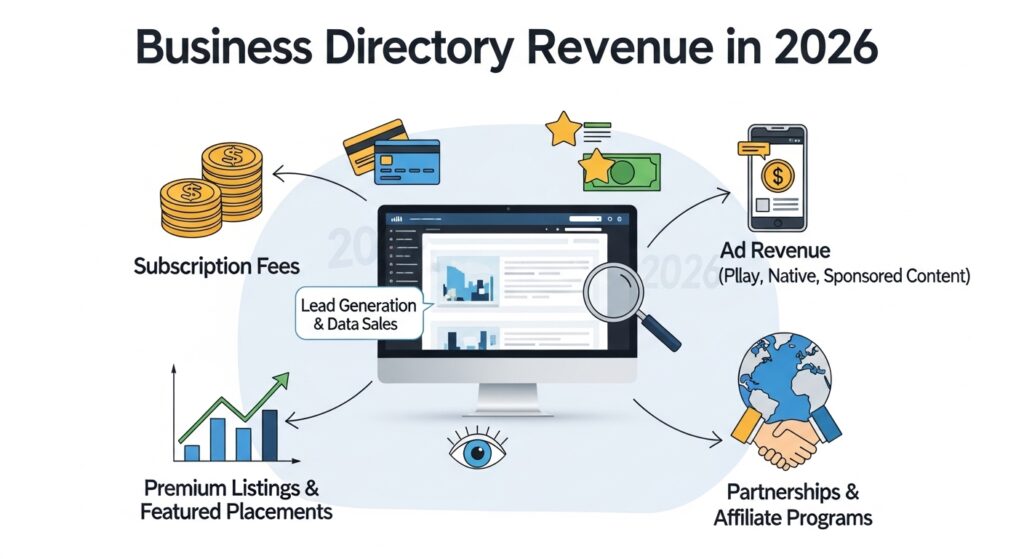
Evolution of Directory Revenue Models
Directory Monetization Timeline
| Era | Monetization Style | Sustainability |
|---|---|---|
| 2015–2019 | Banner ads primarily | Low |
| 2020–2023 | Ads + paid listings | Medium |
| 2024–2026 | Diversified multi-channel | High |
The significant shift in 2026 is revenue diversification. Successful directors no longer rely on a single income stream.
Primary Revenue Models for Business Directories
1. Premium and Featured Listings
Premium placement remains a fundamental revenue source for most directory platforms.
Businesses pay to:
- Appear at the top of category pages
- Display enhanced profile features
- Include additional content like images, videos, or special offers
Modern directories in 2026 use value-based pricing, bundling services such as:
- Enhanced search visibility
- Lead tracking capabilities
- Performance analytics dashboards
Business owners are more willing to invest when they can measure tangible outcomes beyond simple placement.
2. Lead Generation and Pay-Per-Lead Models
Lead generation represents a significant revenue opportunity for directory platforms.
This model works by:
- Collecting user inquiries through the directory
- Qualifying leads based on specific criteria
- Connecting qualified leads with relevant businesses
This approach works particularly well for:
- Service-based businesses
- Real estate professionals
- Legal and medical practices
- Local contractors and tradespeople
Pay-per-lead pricing reduces upfront risk for businesses, which increases adoption rates. According to digital marketplace research from HubSpot, lead-based models often outperform flat subscription pricing in local markets.
3. Advertising and Programmatic Ads
Advertising revenue remains important but has become more sophisticated.
Modern directory advertising includes:
- Contextual advertisements matched to content
- Category-specific ad placements
- Native sponsored content integration
Directories with consistent traffic monetize through:
- Third-party ad networks
- Direct advertising sales
- Sponsored category sections
Key insight: Directories with strong user intent typically achieve better ad performance, making ad inventory more valuable even with moderate traffic volumes.
“All data monetization should comply with applicable privacy laws and clearly disclose how user information is collected and used.”
4. Subscription Plans for Business Users
Many business directories now operate with SaaS-style subscription models.
Subscription tiers commonly include:
- Advanced listing management tools
- Analytics and performance insights
- Review monitoring and response tools
- Lead tracking and history
This creates predictable, recurring revenue streams. Successful directories typically maintain a free basic tier for initial discovery, then upsell premium features as businesses see value.
5. Data and Market Insights
Data monetization has become an important revenue stream in 2026.
Directories collect valuable information, including:
- Search behavior patterns
- Category trend data
- Geographic demand insights
- Consumer preference information
This aggregated, anonymized data can be monetized through:
- Market research reports
- Business intelligence dashboards
- Premium insights for brands and agencies
As data privacy regulations evolve, ethical and transparent data practices become both a legal requirement and a competitive advantage.
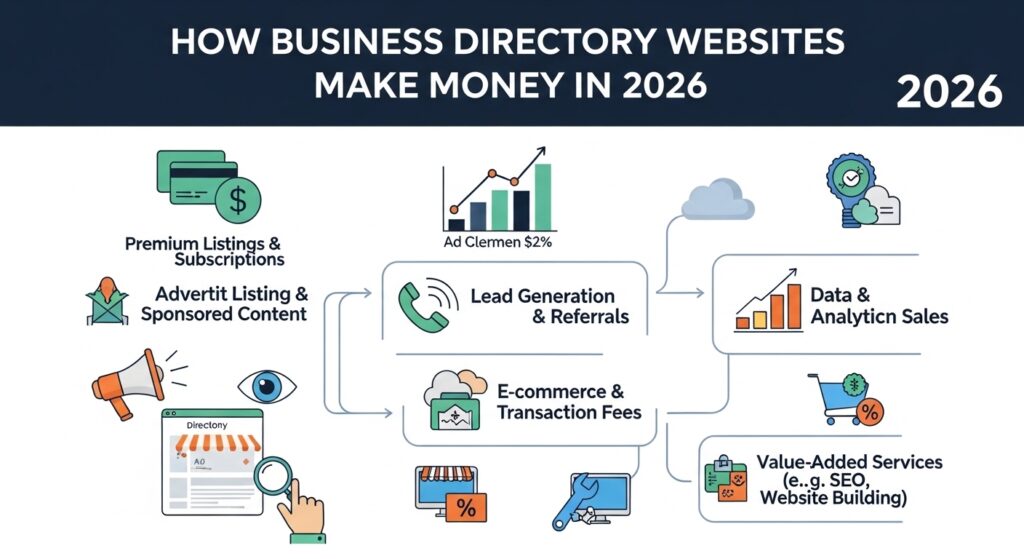
Emerging Monetization Strategies
AI-Powered Matching Services
Some directories now charge businesses for:
- AI-based customer matching algorithms
- Smart recommendation systems
- Predictive lead scoring
Enhanced matching capabilities improve conversion rates and justify premium pricing.
Transaction Fees and Integrated Bookings
Directories that facilitate transactions earn revenue through:
- Commission per completed transaction
- Service fees on bookings
- Payment processing margins
“This follows patterns seen across many modern digital marketplaces,” which combine discovery with transaction completion.
White-Label and Licensing Services
Advanced directories license their platform technology to:
- Industry associations
- Franchise networks
- Local government organizations
This transforms a directory from a single website into a B2B software product with recurring licensing revenue.
Factors That Drive Directory Profitability
Analysis of successful directory platforms reveals several consistent patterns:
Niche Focus Over General Approach Industry-specific directories typically achieve better conversion rates and can command higher pricing than broad general directories.
User Intent Over Traffic Volume 10,000 high-intent users searching for specific services often generate more revenue than 100,000 casual visitors.
Trust and Verification Reviews, business verification, and data accuracy directly impact monetization potential and user retention.
Diversified Revenue Streams The most profitable directories combine at least three different monetization models rather than relying on a single source.
These insights align with marketplace research from platforms like Moz and growth data from SEO industry communities.
Common Monetization Mistakes
Directory platforms often fail due to these errors:
- Premature monetization – Charging users before establishing sufficient traffic and trust
- Ad overload – Excessive advertising that degrades user experience
- Ignoring business ROI – Failing to track and demonstrate value for paying businesses
- Static approach – Treating listings as unchanging rather than dynamic, updatable assets
- Single revenue dependency – Relying entirely on one monetization method
Directories typically fail not because the business model is flawed, but due to poor execution or inadequate understanding of user needs.
Implementation Strategy
For directories looking to optimize monetization in 2026:
- Start with free, high-quality listings to build traffic and trust
- Add one premium feature that solves a real business problem
- Test pricing with small segments before broad rollout
- Measure business outcomes – track leads, calls, and conversions
- Diversify gradually – add complementary revenue streams over time
- Maintain quality standards – revenue shouldn’t compromise user experience
- Stay compliant – follow all advertising and data privacy regulations
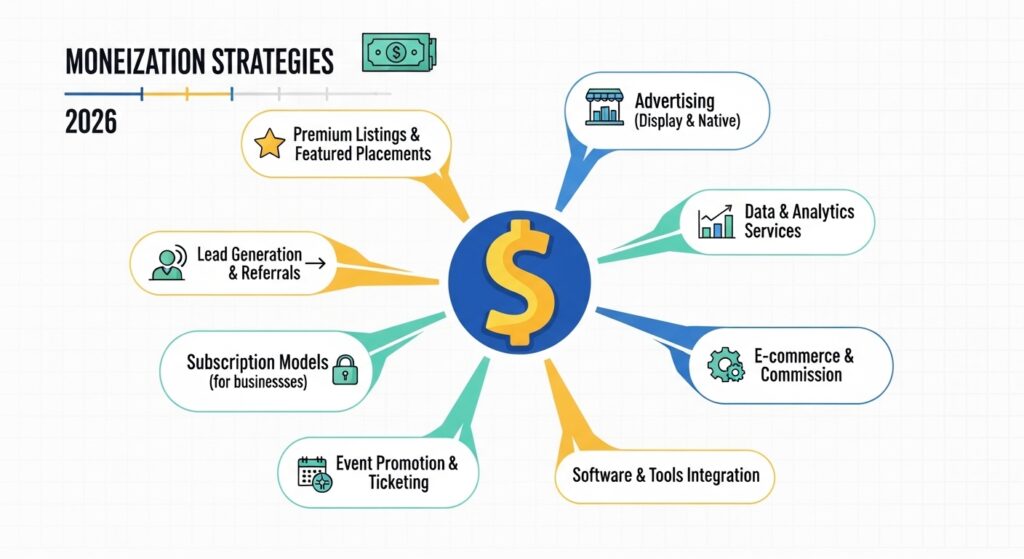
Success Metrics for Directory Monetization
Track these key performance indicators:
Revenue Metrics
- Monthly recurring revenue (MRR)
- Average revenue per listing
- Customer lifetime value
- Revenue by channel
Business Metrics
- Paid listing conversion rate
- Subscription retention rate
- Lead generation volume
- Advertising fill rate
User Metrics
- Search intent quality
- User session depth
- Return visitor rate
- Mobile vs desktop usage
The Directory Opportunity in 2026
Successful directories in 2026 position themselves as growth partners rather than passive listing platforms. The focus has shifted from simple aggregation to:
- Solving specific discovery problems
- Reducing friction between buyers and sellers
- Adding intelligence and verification to listings
- Providing measurable value to both users and businesses
Revenue growth comes from demonstrating clear value and maintaining user trust while monetizing through diverse, complementary channels.
Conclusion: Directory Monetization Today
Business directory websites continue to generate significant revenue in 2026, but the monetization landscape has matured. Successful directories combine multiple revenue streams, including:
- Premium visibility and placement
- Qualified lead generation
- Subscription services
- Strategic advertising
- Data-driven insights
The most successful directories focus on specific niches, prioritize user intent over traffic volume, and obsessively track value delivery for both users and paying businesses.
For those building or operating directory platforms, the opportunity remains substantial provided the approach emphasizes user value, transparency, and adaptability to evolving market needs. Success requires understanding that directories are ultimately marketplace businesses that must serve both supply (businesses) and demand (users) effectively.
“Directories that prioritize accuracy, usability, and trust tend to remain relevant regardless of monetization trends.”